









The past year did not just move technology forward. It reset the baseline for what teams expect from their tools, their data, and their security.
AI moved from experiment to everyday assistant. Cloud and DevOps practices matured into AI-supported operations. At the same time, cybercrime became even more organized and financially driven, with identity attacks and extortion campaigns leading the way.
For leaders planning their roadmap, 2026 will be shaped by three forces that constantly interact with one another: productivity, AI, and cybersecurity. These 2026 technology insights can help you decide where to invest time and budget.
How 2025 Changed the Technology Baseline
A few years ago, AI copilots were early features in a limited set of products. By 2025, they became more common across design, development, content, analytics, and office tools, particularly within larger organizations that had the scale and structure to support adoption.
Several shifts now define the new baseline.
- AI moved from “interesting” to “essential”. Many companies began to treat AI as a workforce multiplier instead of a side project. Natural language interfaces replaced complicated menus and dashboards in many tools.
- Enterprise AI reached mainstream adoption. IBM research found that about 42% of enterprise-scale companies with more than 1000 employees have actively deployed AI in their business.
- Workers reported real productivity gains. A recent enterprise AI study found that 75% of workers say AI has improved either the speed or quality of their work, with typical savings of 40 to 60 minutes per day.
- Cloud migration also accelerated, particularly among organizations modernizing infrastructure to support AI-driven workloads. Many teams leaned into scalable cloud platforms, serverless architectures, and microservices, while DevOps teams began using AI to assist with monitoring, deployments, and incident response. For many SMBs, this period was less about full adoption and more about evaluating where AI could fit securely and cost-effectively.
2026 technology insights for AI and productivity
AI as the foundation, not the add-on
In 2026, AI will be less about a single application and more about how work gets done.
- Copilots and assistants will be embedded across more systems, from office suites to line-of-business platforms.
- AI will support more of the software lifecycle, from prototypes and backend logic to testing and documentation.
- Agentic AI will grow, but with more scrutiny. Agentic systems can pursue goals with a degree of autonomy, rather than only responding to prompts. Gartner predicts that more than 40% of agentic AI projects will be canceled by the end of 2027 because of high costs, unclear value, or weak risk controls.
For leaders, the lesson is clear. AI initiatives that start from a business outcome, with defined guardrails and ownership, are far more likely to last than experiments that simply “add AI” because it feels required.
Hardware, memory, and cloud pressure from AI
As AI models grow, they consume far more memory and storage than traditional applications. That is already reshaping hardware markets.
Recent reporting shows a severe shortage of RAM driven by AI demand, with major memory suppliers prioritizing AI data centers over consumer devices and prices for common RAM kits more than tripling since late 2025.
Micron, one of the largest memory manufacturers, recently announced that by the end of February 2026, it will exit its Crucial consumer business in order to better support large strategic customers in fast-growing AI and data center segments.
For organizations, this has several consequences.
- Hardware refresh cycles may cost more, especially for workstations and servers that need large memory pools.
- Some devices will ship with lower memory configurations to keep prices down.
- Long lead times for specific configurations may become more common as suppliers favor high-volume AI customers.
At the same time, cloud platforms like AWS, Azure, and Google Cloud are adding deeper automation. DevOps roles are shifting toward AI-supported operations, where engineers focus more on strategy, reliability, and governance than on manual pipeline care.
2026 technology insights for cybersecurity
Ransomware, extortion, and financial motives
Cybercrime continues to be driven by one primary goal: financial gain. Microsoft’s latest Digital Defense reporting shows that more than half (52%) of cyberattacks with a confirmed motive are financially motivated, with ransomware and extortion sitting at the center of this activity. The same report notes that in roughly 80% of incidents, attackers attempted to steal data, which reinforces how financially driven these operations have become.
As we move into 2026, this focus on financial return is expected to intensify. Attackers have easier access to tools that support phishing, credential theft, and large-scale automation. Stolen data continues to carry strong resale value, and ransomware groups are using multiple pressure tactics to force payment. These factors point to a year where financially motivated attacks remain the dominant threat for most organizations.
This is why having a clear ransomware response plan matters. If you would like a resource to help guide internal planning, our free downloadable Ransomware Response Checklist offers a starting point for reviewing the steps your team should take before and during an incident.
Identity is the new front door
Identity attacks have become one of the simplest and most common ways attackers try to access an environment. Instead of looking for technical gaps, they focus on signing in as a real user. Automated tools make this easy, which is why the volume keeps rising. More than 97% of identity-based attacks rely on password attempts, and identity-related attacks grew by 32% in the first half of 2025. The good news is that strong controls make a real difference. Phishing-resistant multifactor authentication can stop more than 99% of these attempts, even if an attacker already has the correct username and password.
In 2026.
- Identity protection is no longer a check box. It is a frontline control.
- Password policies are not enough. Organizations need strong MFA, conditional access, and ongoing monitoring of sign-in risk.
- User awareness needs to extend beyond generic phishing awareness to include real-world examples of consent phishing, OAuth abuse, and session theft.
The modern attack surface and why it matters
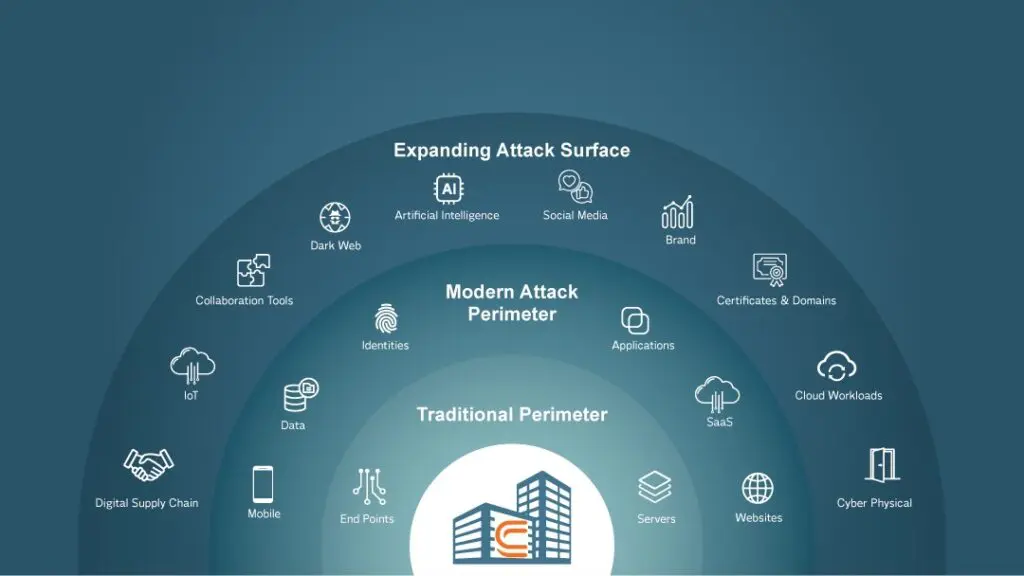
In 2025, organizations saw significant growth in the number of systems, platforms, and connections that make up their environment. Remote work, SaaS adoption, supplier connectivity, and cloud expansion all contributed to a much wider digital footprint. What was once a single, clearly defined perimeter has become a distributed landscape of applications, identities, and data sources.
In 2026, this expansion continues, and so does the need for visibility. The image above shows how threats now reach far beyond the traditional network. Data, mobile devices, identities, cloud workloads, SaaS platforms, websites, digital supply chains, social platforms, collaboration tools, and even brand presence all create new points of risk.
A broader attack surface does not automatically mean greater vulnerability. It means leaders need a clearer picture of what truly exists in their environment. When organizations understand every layer where threats can appear, it becomes easier to set priorities, strengthen controls, and focus investment where it matters most.
Attackers and defenders both using AI
In 2025, attackers used AI to improve how they phish, steal credentials, create synthetic content, and identify vulnerabilities at scale. These tools lowered the skill barrier and increased the volume of cyber activity across sectors.
In 2026, defenders will rely more heavily on AI to process large volumes of identity data, endpoint signals, email patterns, cloud activity, and vulnerability information. AI assisted detection helps close gaps faster and improves response. While AI will influence both sides, the fundamentals remain the same. Strong identity controls, layered security, and clear governance still matter the most.
The human element and the need for clarity
Looking ahead, 2026 will not only be about more capable systems. It will also be about renewed focus on the human side of technology.
- There will be stronger pushback against synthetic and deepfake content that drowns out authentic human voices.
- Organizations will pay more attention to the psychological impact of constant interaction with chatbots and virtual environments.
- Skills such as critical thinking, ethics, and clear communication will matter even more as AI takes on mechanical tasks.
For business and IT leaders, this means two things.
First, employees need support and training, not just new tools. Second, Teams want technology that saves time and reduces effort. They also need confidence that decisions are guided by human judgment and strong governance. Skills such as communication, critical thinking, and ethical decision-making will continue to grow in importance as automation expands.
What leaders can do with these 2026 technology insights
To close, here is a practical checklist you can use as you shape your plans for the year ahead.
Review where AI is already in your environment
Map which tools already include AI features, where staff are using them, and whether there is any unmanaged AI adoption. Link each use case to a clear outcome, such as faster cycle times, lower error rates, or better client response.
Strengthen identity and access controls
Treat identity as the primary perimeter. Enforce MFA, consider passwordless sign-in (Single sign-on) where possible, and use conditional access to protect high-risk users and applications.
Map your full attack surface
Use the modern attack surface model to catalog your data, devices, cloud workloads, SaaS tools, and vendor connections. Identify which areas have monitoring and which do not.
Prepare for financially motivated attacks
Assume that ransomware, extortion, and data theft are primary risks. Test your backup and recovery processes, incident response plan, and legal and communication workflows.
Plan for hardware and cloud cost shifts
Account for higher memory and storage costs driven by AI demand and for ongoing reliance on cloud platforms. Align your refresh plan with your AI and data strategy so you are not surprised by capacity gaps. If you want to learn more about budgeting or your IT and Cybersecurity Strategy in general, watch the recording of our recent webinar on driving business growth through a smarter IT Strategy
Build clear governance for AI
Create or update an AI usage policy that covers acceptable use, data handling, privacy, and model risk. Align this with your existing security and compliance program.
Not sure where to get started? Reach out to Convergence Networks. Our vCIOs can help you build a technology roadmap to ensure your technology grows with your business.