










Nonprofits run on trust. Donors expect their contributions to be handled responsibly, beneficiaries rely on their data being protected, and partners depend on consistent operations. That trust is fragile, and cybersecurity now plays a direct role in maintaining it. While most leaders recognize cyber risk, many are not prepared to respond. About 70% of NGOs are unsure whether they could recover from a disruptive cyberattack, turning risk into real operational impact.
Moreover, Nonprofits are managing more data across more systems, often with limited internal resources. Distributed teams, volunteers, and third-party access increase exposure, making it harder to control who has access and how securely they operate. Attackers recognize this gap and target organizations where valuable data exists, but defenses are inconsistent. Cybersecurity is no longer just an IT concern. It is a leadership priority tied to continuity, funding, and long-term stability.
Cybersecurity Risks for Non-Profits
Understanding risk in a nonprofit context requires looking beyond technical vulnerabilities and focusing on how attacks affect operations, funding, and reputation.
Phishing remains the most common entry point. About 83% of organizations experienced a phishing attack in the last year. Nonprofits are particularly exposed because communication with donors, sponsors, and vendors is frequent and often time-sensitive. A well-crafted email that appears to come from a donor or board member can lead to credential theft or unauthorized financial transfers.
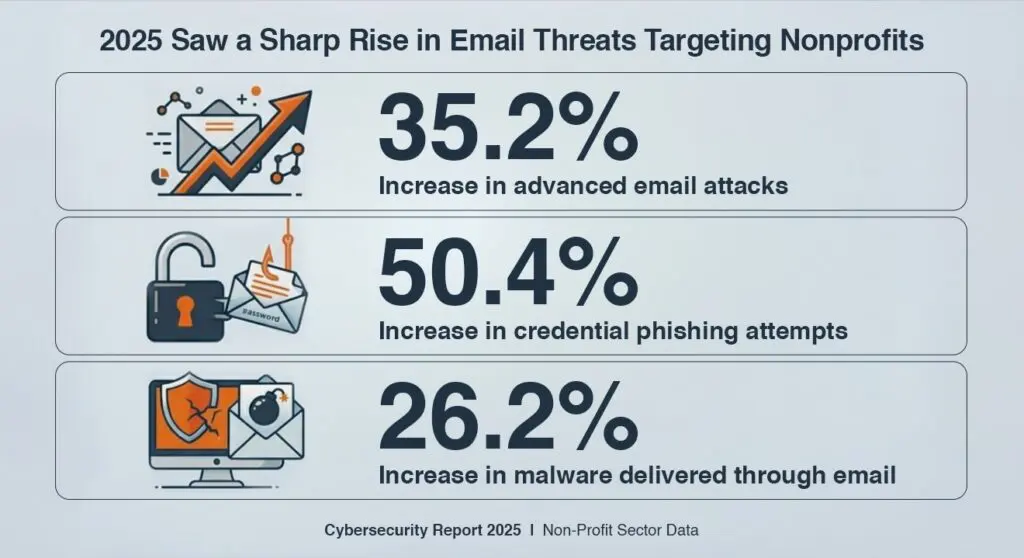
Ransomware poses a direct threat to service delivery. For nonprofits, system downtime is not just an inconvenience. It can halt programs, delay services, and disrupt communities that rely on them. Losing access to donor databases or case management systems for even a few days can have a measurable impact on funding and outcomes.
Data exposure carries both ethical and legal consequences. Nonprofits often handle sensitive personal information, including financial records and data related to vulnerable populations. A breach does not just create compliance issues. It directly impacts the people the organization is trying to support.
Limited internal resources increase risk. Many nonprofits lack dedicated cybersecurity leadership or structured security programs. A study by NTEN found that only about 40% of nonprofits provide regular cybersecurity training. This creates gaps that attackers can exploit through social engineering and credential-based attacks.
Reputation damage has long-term effects. Donor trust is difficult to rebuild once lost. A single incident can reduce future donations, delay grants, and impact partnerships. Cybersecurity incidents are no longer contained events. They influence how stakeholders evaluate the organization moving forward.
Why Nonprofits Are an Attractive Target for Cybercriminals
Consider a simple but damaging scenario. An attacker gains access to your website or donation platform and alters the banking details associated with online contributions. Donors continue giving, unaware that funds are being redirected. In other cases, a compromised donation page can be used to collect card details, exposing donors to fraud while the organization loses both revenue and trust. This is where cybersecurity for nonprofits becomes critical, as even small gaps can lead to significant financial and reputational damage.
Cybercriminals know nonprofits are mission-driven and use that urgency to their advantage. They research organizations, map users and systems, and spend days or weeks finding the easiest way in. In many cases, they quietly gain access, move through email and cloud accounts, and wait for the right moment to act.
Nonprofits offer a strong return for that effort. Donor records, payment details, healthcare data, and personal information can be sold or used for fraud. Timing and access make these attacks effective. When teams are moving quickly, a single convincing message or small system change can lead to financial loss.
The Business Impact of a Cyber Incident
For nonprofit leaders, the most important question is not how an attack happens, but what it means for the organization when it does.
A successful attack can lead to:
- Loss of access to critical systems and data
- Interruption of programs and services
- Financial loss through fraud or ransom payments
- Increased operational costs for recovery and investigation
- Regulatory penalties depending on the nature of the data exposed
- Long term erosion of donor and stakeholder trust
These are not isolated IT issues. They affect fundraising, service delivery, and overall organizational stability. Cybersecurity decisions should be evaluated with the same level of importance as financial planning and program strategy.
5 Cybersecurity Controls Every Nonprofit Should Have
Strong cybersecurity does not start with tools. It starts with structure, accountability, and consistency. The following controls form the foundation of a resilient nonprofit security program.
1. Implement a Clear Cybersecurity Policy
A cybersecurity policy sets expectations across the organization. It defines how staff should handle data, devices, passwords, and email. It also establishes accountability and provides a reference point for decision making.
This policy should not be static. It needs to be reviewed regularly, communicated clearly, and reinforced through training. As the organization grows and adopts new technologies, the policy should evolve to reflect those changes.
2. Establish Strong Data Governance
Nonprofits need clear visibility into what data they collect, where it is stored, and who has access to it. Donor information, financial records, and personal data should only be accessible to authorized individuals.
Data governance also includes understanding legal and regulatory requirements. Whether it involves donor privacy laws or healthcare data regulations, leadership must ensure that data handling practices align with compliance expectations.
3. Provide Cybersecurity Training for Staff
Technology alone does not prevent breaches. People play a critical role in identifying and stopping threats. Regular training helps staff recognize phishing attempts, suspicious activity, and risky behaviour.
Given that only about 40% of nonprofits provide ongoing training, this is one of the most immediate opportunities to reduce risk. Training should be practical, relevant, and continuous rather than a one-time initiative.
4. Use Multi Factor Authentication
Multi factor authentication is one of the most effective ways to prevent unauthorized access. It blocks more than 99.9% of automated account compromise attempts.
MFA should be required for email, cloud platforms, and any system that provides access to sensitive data. This is a low-cost control with a high impact on reducing risk.
5. Maintain Secure Backups
Backups are essential for recovery. In the event of ransomware or system failure, they provide a way to restore operations without paying a ransom.
Backups should be encrypted, immutable, tested regularly, and stored separately from the primary network. Leadership should also ensure that recovery processes are documented and tested to avoid delays during an actual incident.
Building a Stronger Cybersecurity Foundation
Beyond core controls, nonprofit leaders should focus on building a structured approach to managing cyber risk. This involves aligning security initiatives with operational priorities and ensuring that decisions are made with a clear understanding of risk and impact.
Conduct a Risk Assessment
A risk assessment provides visibility into current vulnerabilities and potential threats. It helps prioritize investments and ensures that resources are allocated effectively. This should be conducted regularly and updated as the organization changes.
Implement Strong Password Policies
Weak or reused passwords remain a common entry point for attackers. Enforcing strong password requirements and encouraging the use of password managers can significantly reduce this risk.
Educate Board Members on Cybersecurity Awareness
Cybersecurity is not just an operational issue. It is a governance issue. Board members should understand the risks, the organization’s current posture, and the potential impact of an incident. This ensures that cybersecurity is included in strategic discussions and funding decisions.
Use Secure Communication Channels
Sensitive information should not be shared through unsecured channels. Implementing secure communication tools and guidelines helps protect data in transit and reduces the risk of interception.
Regularly Update and Patch Systems
Outdated systems create vulnerabilities that attackers can exploit. Regular patching and updates ensure that known security issues are addressed promptly. This should be managed through a structured process rather than ad hoc updates.
Develop a Cyber Incident Response Plan
An incident response plan defines how the organization will respond to a cyber event. It should include roles, responsibilities, communication protocols, and recovery steps.
This plan should be tested through exercises to ensure that teams are prepared. During an incident, speed and clarity are critical. A well-defined plan reduces confusion and helps contain the impact.
Moving from Reactive to Resilient
Many nonprofits approach cybersecurity reactively. Controls are implemented after an incident or when a requirement arises. This approach creates gaps and leaves the organization exposed.
Leadership teams need to shift toward a proactive model where cybersecurity is integrated into planning, budgeting, and operations. This includes:
- Aligning cybersecurity investments with business priorities
- Treating cybersecurity as part of risk management rather than IT overhead
- Ensuring ongoing training and awareness across the organization
- Establishing accountability at both the leadership and operational levels
Cybersecurity is not about eliminating all risk. It is about managing risk in a way that protects the organization’s ability to operate, serve, and grow.
What This Means for Leadership
Nonprofits exist to create impact. Cybersecurity supports that mission by ensuring that operations remain stable, data remains protected, and trust remains intact.
The organizations that will succeed in the coming years are those that treat cybersecurity as a leadership priority rather than a technical afterthought. This often includes working with experienced partners that deliver Managed IT Services for Nonprofits, helping bring structure, visibility, and accountability to cybersecurity efforts.
For nonprofit leaders, the question is not whether to invest in cybersecurity. It is whether the organization is prepared to operate without it.