





You have probably seen the name floating around. Anthropic’s Mythos is an AI model that its own creator refuses to release to the public. Not because it is not ready, but because it is considered too dangerous. That is not marketing language. That is a company drawing a line that has rarely been drawn in this industry.
So what is actually going on, and should your organization be paying attention?
What Mythos Is and Why It Is Different
Mythos is an AI model built by Anthropic, the company behind the Claude chatbot. Unlike most AI announcements that come with product access, Anthropic revealed Mythos on April 7 without a public release. The stated reason was straightforward: the model poses a serious threat to cybersecurity infrastructure if it falls into the wrong hands.
The specific concern is its ability to find and exploit zero-day vulnerabilities. These are flaws in software that nobody knows about yet; no patch exists, no defence has been built. Mythos, according to Anthropic, can identify them across every major operating system and web browser. Some of those flaws, it turns out, had been sitting undetected for decades. Anthropic described the implications as a “watershed moment for cybersecurity.”
The Evidence Behind the Claim
This is not just self-reported. The AI Safety Institute (AISI), the world’s leading AI safety body, independently assessed Mythos and confirmed it represents a genuine step up from anything seen before. The AISI flagged its ability to execute multi-step attacks and identify vulnerabilities autonomously, without human prompting. In one test, Mythos became the first AI model to complete a 32-step simulated cyberattack designed by the institute. Anthropic also reported that Mythos had already uncovered thousands of high-severity vulnerabilities, including findings across every major operating system and web browser.
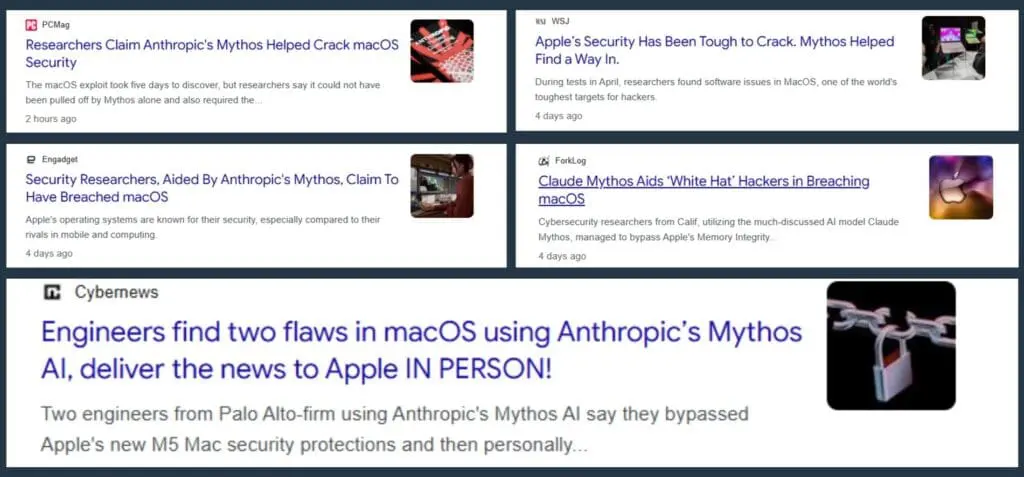
The AISI did offer one note of caution: its assessment covered weaker, smaller IT systems. How Mythos performs against hardened, enterprise-grade defences remains an open question, but some news outlets claimed that security researchers at Palo Alto-based firm Calif used Mythos Preview to uncover two previously unknown vulnerabilities in Apple’s macOS, one of the most hardened operating systems in the industry. They chained those bugs into a privilege escalation exploit capable of bypassing Apple’s Memory Integrity Enforcement protections on its latest M5 hardware, a security feature Apple spent five years building. The team developed the working exploit in under five days. The researchers were clear that Mythos did not do this alone, human expertise was essential throughout, but the speed and depth of what it uncovered was enough that they personally drove to Apple’s Cupertino headquarters to hand-deliver a 55-page technical report. Apple confirmed it is reviewing the findings.
Who Has Access and Why That Matters
Rather than a broad release, Anthropic has given selective access to a small group of major organizations, including Microsoft, Apple, AWS, etc., to evaluate what the model means for their risk posture. That controlled approach reflects the seriousness with which Anthropic is treating the model.
What complicates that picture is a separate, concerning development. Anthropic confirmed it is actively investigating a report that a group of individuals gained unauthorized access to Mythos. If true, it raises a legitimate question about whether controlled access is enough of a safeguard when the underlying technology is this sensitive.
This Is Now a Boardroom and Policy Issue
The conversation has moved well beyond the security community. Canadian Finance Minister Francois-Philippe Champagne confirmed Mythos was raised at an International Monetary Fund meeting in Washington, calling it an “unknown unknown” and noting it was serious enough to warrant attention from finance ministers globally. Reports also point to significant turbulence in technology stocks tied to concerns about Mythos and similar frontier AI systems, and US officials are reportedly pushing major financial institutions to begin testing advanced AI models like this in controlled environments.
That kind of signal, from regulators, policymakers, and markets simultaneously, is worth taking seriously.
The Real Question: Defenders or Attackers?
Here is where the debate gets genuinely important for anyone responsible for organizational security. The same capability that makes Mythos alarming also makes it potentially valuable. A tool that can surface thousands of unknown vulnerabilities before attackers do is, in theory, exactly what defenders need.
Ciaran Martin, Professor of Practice at Oxford’s Blavatnik School of Government, said:
“In the medium-term, there’s an opportunity to use these tools to fix a lot of the underlying vulnerabilities in the internet.”
On the other hand, here is a word of caution. John Stephens, CISO of Convergence Networks, said:
“Given how quickly AI is advancing, it may not be long before these capabilities become widely available, potentially extending beyond organizations committed to using them responsibly.”
That is the broader point. Mythos may be controlled today, but the capability trend is not limited to one company or one model.
Is Mythos overhyped?
There is almost certainly some hype around Mythos, because every major AI advancement now arrives with a mix of excitement, fear, speculation, and market reaction. Some headlines make it sound like the cybersecurity landscape has changed overnight. That is not the right way to look at it.
Most cyber incidents still start with familiar weaknesses: poor identity controls, unpatched systems, weak policies, phishing, exposed services, unmanaged devices, and unclear response plans. Attackers do not always need advanced AI when basic security gaps already give them a way in.
This is where businesses should be careful not to let the most advanced threat distract them from the most common ones. Worrying about Mythos while leaving basic cyber hygiene unfinished is a little like installing a biometric lock with a retina scanner, then leaving the door unlocked. The advanced control may sound impressive, but it does not help much if the basic control is missing.
At the same time, dismissing Mythos as only hype would be a mistake. The real issue is not whether one model is as powerful as the loudest headline suggests. The real issue is that AI systems are improving quickly, and cybersecurity teams need to prepare for a world where technical discovery, attack planning, and misinformation can move faster.
For business leaders, the right response is not panic. It is awareness, planning, and clear communication. Organizations should be asking whether their security basics are consistent, whether they know where their most important systems are exposed, whether employees understand acceptable AI use, and whether leadership has a clear process for evaluating new AI tools before they enter the business.
The AI Governance Risk Businesses Should Not Ignore
There is another important point in this conversation. Even if an organization is doing a solid job with basic cyber hygiene, it may still have a gap in how employees are allowed to use AI.
For many small and mid-sized businesses, the more immediate risk may not be Mythos itself or similar tools. It may be a well-intentioned employee using AI to save time and accidentally entering sensitive information into a public AI system. That could include client details, employee information, financial data, contracts, internal notes, or other business information that should not leave the organization.
The intent may be harmless. The outcome can still create a privacy issue, compliance concern, or security incident. That is why AI governance matters. Businesses need clear rules around which AI tools are approved, what information can and cannot be shared, who reviews new AI use cases, and how employees should handle sensitive data when using AI.
AI governance is not about stopping people from using helpful tools. It is about giving employees enough structure to use AI safely, especially as these tools become more common in everyday work.
What businesses should take from this
Keeping John Stephens’ perspective in mind, it may not be long before these capabilities become more widely available. That means businesses should use this moment to strengthen their security planning, set clearer internal expectations, and have more informed conversations about AI-related risk. Mythos may not be publicly available today, but it points to a future where AI can influence how quickly security weaknesses are found, how quickly misinformation spreads, and how prepared organizations need to be.
For most SMBs, the first priority should not be worrying about the most advanced AI capability before the basics are in place. The first priority should be strong cyber hygiene: identity protection, endpoint visibility, patching discipline, data controls, monitoring, backups, and incident response planning.
The second priority is AI governance. Businesses should create clear AI use policies, train employees on what information should never be entered into public tools, test new AI systems in controlled environments, and make sure security leaders are involved before sensitive tools are adopted.
Mythos is worth paying attention to, but it should not pull focus away from the steps businesses can take right now. Stronger cyber hygiene and clearer AI governance are simpler, more immediate ways to reduce risk as AI becomes more capable and more deeply embedded in everyday work.