











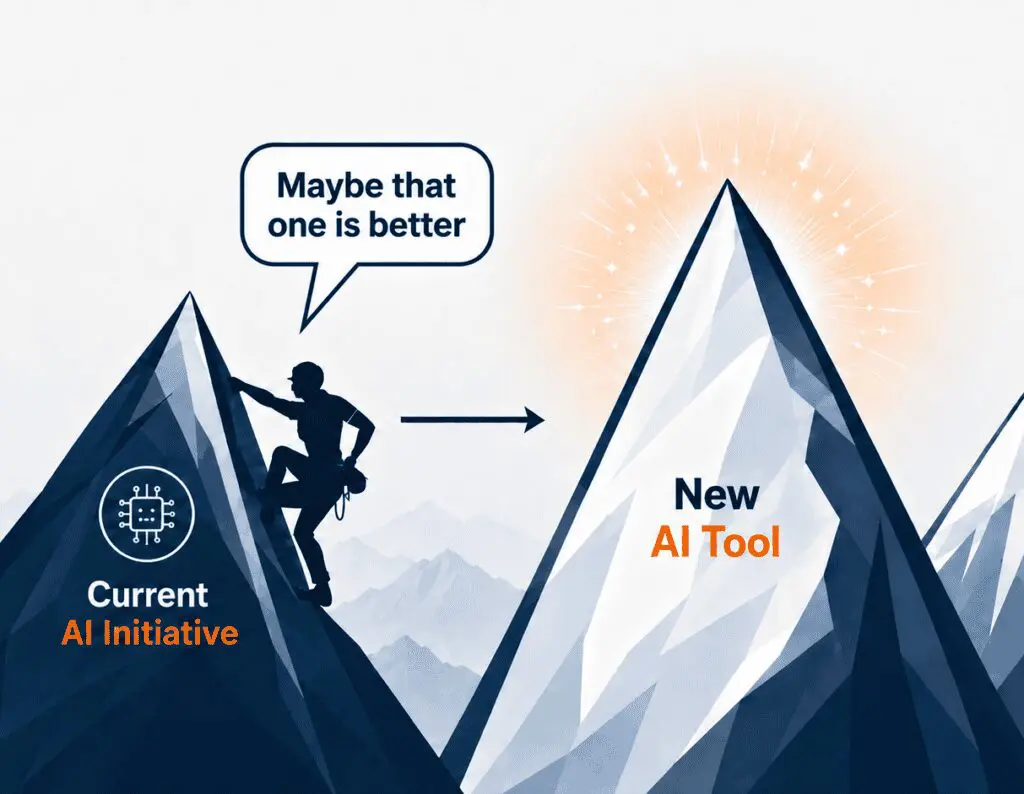
Every week brings a new AI tool, a new vendor demo, and a new headline claiming that businesses without AI are already falling behind. That pressure has a name: shiny object syndrome. It is the pull to buy the newest thing because it is new, not because it solves a specific problem your business has. AI is especially prone to this because the demos are impressive and the fear of missing out is real.
The businesses getting measurable value from AI are not the ones with the most advanced models. They are the ones that asked hard questions before spending money. A 2024 RAND Corporation study of failed AI projects found that the leading causes were rarely technical. Unclear problem definition, weak data foundations, and a lack of governance were the reasons most projects stalled or never scaled.
The lesson is simple. Without a proper roadmap, AI is just another tool sitting on the shelf, and an expensive one. Which is why we recommend asking yourself these five questions before making your next AI investment
1- What Business Problem Are We Actually Trying to Solve with AI?
This is the question most AI investments skip. Leaders start with the tool and work backward to find a justification, when the process should run in the other direction. Start with a real, measurable pain point, such as slow invoice processing, an overwhelmed help desk, or a sales team spending hours writing proposals.
This is where use case analysis matters. Define the problem, determine whether AI is the right solution, and establish what a successful outcome would look like. If you cannot explain what the AI should improve or how you will measure the result, the use case probably needs more work.
RAND research into AI project failures found that organizations often struggle because they misunderstand the problem they are trying to solve or become distracted by new technology instead of focusing on a genuine user need. That is the difference between an AI strategy and shiny object syndrome. One starts with an outcome, while the other starts with a tool.
2- Is Our Data Actually Ready for AI?
AI is only as useful as the information available to it. Outdated documents, duplicate information, inconsistent records, poor permissions, and unclear data ownership can quickly undermine an otherwise promising AI project.
Before connecting AI to business information, understand where that information lives, who owns it, who can access it, and whether employees already trust its accuracy. Having years of data does not necessarily mean you have the right data for a particular AI use case.
In some cases, the first phase of an AI roadmap may have very little to do with AI itself. Data cleanup, information management, permission reviews, and governance may need to happen first so the technology has a reliable foundation to work from.
3- Do We Know How AI Is Already Being Used Inside Our Organization?
Many organizations assume they are starting from zero. In reality, employees are usually well ahead of leadership. According to recent research, up to 1 in 5 organizations do not know whether employees are using unsanctioned AI tools, and for generative AI that figure has nearly tripled since 2025.
This is the shadow AI problem, and it matters for two reasons. First, unsanctioned tools are a data security risk, since sensitive customer or company information may be pasted into consumer applications that retain and reuse it. Second, shadow AI is a signal. The tools your team is already reaching for tell you where the real demand is. We covered how to get visibility into this in our post on Shadow AI in the workplace, and it is a good starting point before any formal investment.
4- Do We Have the People, Skills, and Governance to Make AI Work?
Buying AI licenses is relatively easy. Making AI part of the business requires ownership, training, policies, oversight, and clear responsibility for the results.
Organizations should know who approves AI use cases, who manages the technology, who reviews security concerns, when human review is required, and how employees will be trained. Those responsibilities become increasingly important as AI expands from a small pilot into multiple teams and workflows.
AI can also change how work moves through the organization. A useful roadmap considers the technology and the business process together so that time saved in one area actually creates value across the broader workflow.
5- Can We Clearly Explain the Cost and the Expected Return?
The cost of AI is rarely limited to the subscription fee. Implementation, integration, data preparation, training, security, governance, support, compliance, and ongoing management can all contribute to the total cost of ownership.
The expected return should be equally clear. Statements such as “AI will improve productivity” are difficult to measure. Instead, identify the process being improved and establish a baseline so you can measure whether AI actually reduces time, lowers costs, speeds up a workflow, or produces another meaningful result.
Readiness costs also matter, a recent research reports that 86.9% of organizations had delayed generative AI deployments because of data security and data management concerns, with an average delay of 5.88 months. A realistic AI business case should account for what needs to happen before the organization can capture the expected value.
What to do if you answered no
Most businesses will answer no to at least one of these questions, and that is not a reason to stall. It is a reason to sequence the work correctly. A realistic AI roadmap usually starts with the unglamorous parts, such as identifying where AI could help, assessing each opportunity based on business value, feasibility, data readiness, security, cost, and organizational readiness, then prioritizing the opportunities that make the strongest business case.
Some organizations may be ready to begin testing a use case immediately. Others may first need to address data permissions, governance, employee training, security controls, or technology gaps before making a larger investment.
The goal is not to find as many places as possible to use AI. It is to identify where AI genuinely makes sense, understand what is required to make those use cases successful, and invest with a clear expectation of what the business should receive in return.